Every espresso machine that heats water eventually fills up with limescale — the chalky mineral residue left behind as hard water evaporates inside the boiler. Descaling is the process of dissolving that buildup with an acidic solution before it clogs your machine's internals. It works the same way on a $150 home machine and a $3,000 prosumer setup: run a descaling solution through the system, then rinse thoroughly with fresh water.
How often you need to do this depends mostly on your water and how often you brew, but as a baseline, most manufacturers recommend descaling every one to three months. Skip it long enough and the cost isn't a bad-tasting shot — it's a machine that stops working, sometimes permanently.
What Happens If You Don't Descale
Limescale doesn't sit quietly in one spot. It builds up inside the boiler walls, along the internal tubing, and around the solenoid valves that control water flow — and every part it touches gets worse at its job over time.
Here's the typical progression:
- Slow, weak flow. Scale narrows the internal passages the water travels through, so shots take longer to pull and pressure drops. Eventually you get dripping instead of a steady stream.
- Water that never gets hot enough. Scale acts as an insulating layer on the boiler's heating element, so the element has to work harder to reach the same temperature — and often can't. The result is sour, under-extracted shots that taste thin no matter how you dial in your grind.
- Scale flaking into your cup. As deposits build up and break loose, flecks of mineral scale can end up in your espresso or the water it's brewed with.
- A strained pump and, eventually, a dead one. Your pump has to push harder against restricted lines. Pumps are usually the first expensive part to fail on a badly scaled machine, and boilers aren't far behind.
- Blocked solenoid valves. These small valves control when and where water flows. Scale buildup is one of the most common reasons a machine stops responding to brew commands entirely.
- A voided warranty. Most manufacturers explicitly exclude scale damage from warranty coverage, and some will inspect a failed unit specifically for it. If a technician opens up your machine and finds heavy scale, you're paying for the repair yourself.
Put simply: a bottle of descaler costs about the same as a coffee drink at a café. A pump replacement or a machine that won't heat past lukewarm costs a lot more than that, and a full warranty claim denial can mean replacing the machine outright. Descaling on schedule is the cheapest insurance your espresso machine has.
How Often to Descale (by Water Hardness)
The single biggest factor in how fast scale builds up is your water's mineral content — specifically calcium and magnesium, measured as "hardness." Harder water means faster scale buildup, full stop.
| Water hardness | Descale every |
|---|
| Soft (naturally low mineral content, or already filtered/softened) | 3 months |
| Medium (typical municipal tap water) | 1–2 months |
| Hard (high mineral content, common with well water or certain regions) | 3–4 weeks |
If you don't know your water hardness, cheap test strips give you an answer in about 30 seconds — more on that below. Frequency of use matters too: a machine that runs a dozen shots a day scales up faster than one used once on weekends, so treat these ranges as a starting point and adjust based on how quickly your machine's performance changes.
Not sure which band you fall into? Our descaling frequency calculator turns your water hardness and how often you brew into an estimated interval in a few clicks.
Many machines also take the guesswork out of this entirely. If yours has a descale indicator light — usually triggered by a shot counter or a water-hardness setting you configure during setup — treat that light as the authoritative signal and descale as soon as it appears, even if it's earlier than you expected.
Descaler vs. Vinegar — Use the Right One
It's tempting to reach for white vinegar since it's already in your kitchen and it is acidic enough to dissolve some limescale. Nearly every espresso machine manufacturer specifically advises against it, and for good reason:
- It can corrode internal parts. Vinegar's acetic acid is harsher on rubber seals, gaskets, and aluminum components than a purpose-built descaler, and repeated use accelerates wear on parts that are expensive or impossible to replace individually.
- It leaves a lingering taste and smell. Vinegar residue is notoriously hard to rinse out completely, and what doesn't rinse out ends up in your next several shots.
- It can void your warranty. Because manufacturers call out vinegar by name in their maintenance guidance, using it after a documented recommendation not to is exactly the kind of thing that gets a claim denied.
A proper descaler — typically citric acid-based, either a branded product made for your machine or a general-purpose espresso descaler — is formulated to dissolve mineral scale without attacking the rubber and metal parts your machine depends on, and it rinses clean. It costs a few dollars more than a bottle of vinegar. Given what's at stake, that's not a real trade-off. (Own a Nespresso specifically? We go deeper on whether you can use vinegar to descale a Nespresso.)
What You Need to Descale
Urnex
No rating yetCheck Price →$29.98· as of Oct 27, 2026i
Product prices and availability are accurate as of the date/time indicated and are subject to change. Any price and availability information displayed on Amazon.com at the time of purchase will apply to the purchase of this product.
Third Wave Water
No rating yetCheck Price →$29.00· as of Oct 27, 2026i
Product prices and availability are accurate as of the date/time indicated and are subject to change. Any price and availability information displayed on Amazon.com at the time of purchase will apply to the purchase of this product.
JNW Direct
No rating yetCheck Price →$8.99· as of Oct 27, 2026i
Product prices and availability are accurate as of the date/time indicated and are subject to change. Any price and availability information displayed on Amazon.com at the time of purchase will apply to the purchase of this product.
Urnex
No rating yetCheck Price →$12.57· as of Oct 27, 2026i
Product prices and availability are accurate as of the date/time indicated and are subject to change. Any price and availability information displayed on Amazon.com at the time of purchase will apply to the purchase of this product.
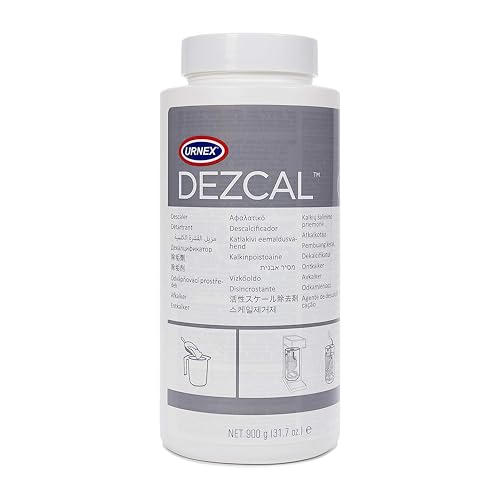
A citric-acid descaler like Dezcal handles the mineral side of maintenance; if your machine also has a portafilter and group head (rather than a fully automatic bean-to-cup design), a separate group-head cleaner like Cafiza takes care of coffee oil buildup, which is a different problem that descaling alone won't fix. Water hardness test strips tell you which frequency band from the table above actually applies to you, and a remineralizer for distilled water — covered next — tackles the problem before it starts.
Prevent It Coming Back
The most reliable way to slow scale buildup is to change the water going into the machine in the first place. Two approaches work, and they're not mutually exclusive:
Start from distilled or reverse-osmosis water. Distilled and RO water have had virtually all dissolved minerals removed, which means there's almost nothing left to precipitate out as scale inside your boiler. The tradeoff is flavor: water with zero mineral content extracts espresso poorly and tastes flat, which is why products like Third Wave Water exist — you add a small packet of minerals back into distilled water to hit a flavor-optimized mineral profile, without reintroducing the calcium and magnesium load that causes scale. It's a remineralizer, not a filter, and it's worth understanding that distinction: this approach is a different strategy than filtering tap water, and for scale prevention specifically, starting from distilled water and remineralizing it gives you far more control than filtering alone.
Test your water, and act on what you find. If you're on municipal tap water and don't want to switch to distilled water full time, testing is still worth doing — it tells you exactly which frequency in the table above applies to your situation, rather than guessing. Test strips are inexpensive and give you a hardness reading in under a minute.
Check price
Between the two, the water-source change does more heavy lifting for scale prevention long-term, but testing is the fastest way to know whether you actually need to make that change or whether your current setup is already in the soft-to-medium range.
Descaling Your Specific Machine
The general principles above apply across brands, but the exact steps — how to enter descaling mode, how long to run the cycle, and how many rinse cycles to do — vary by manufacturer and sometimes by model. Always check your machine's manual for the specifics, and use these brand guides for step-by-step instructions:
Whichever machine you own, the fundamentals stay the same: use a real descaler instead of vinegar, follow the frequency that matches your water hardness, and rinse thoroughly. Do that consistently and it's the cheapest insurance your machine will ever get.