Best Espresso Machine for Small Kitchens (2026)
Researched by Netspresso Editorial · Published Oct 13, 2026 · Updated Oct 18, 2026
The best espresso machine for small kitchens is the Breville Bambino Plus for most people: it is under 8 inches wide, heats in about three seconds and steams milk on its own. If every inch counts, the De'Longhi Dedica Duo is the slimmest real espresso machine here at roughly 6 inches wide. Most small-kitchen lists stop at 'compact' and never mention height under wall cabinets, where the grinder goes, or how often a tiny drip tray needs emptying. We sized the whole setup from eight hands-on video reviews and their owner comment threads, so you can measure your counter once and buy the right machine.
| Pick | Machine | Rating | Buy |
|---|---|---|---|
| Best Overall for Small Kitchens | Breville Bambino Plus | 4.5 | Check Price → |
| Slimmest Footprint | De'Longhi Dedica Duo | 4.2 | Check Price → |
| Best Budget | De'Longhi Stilosa | 4 | Check Price → |
| Best Build If You Have the Height | Gaggia Classic Pro | 4.5 | Check Price → |
1Best Overall for Small Kitchens: Breville Bambino Plus
About 7.7 inches wide, ready in seconds, with automatic milk texturing that four of the eight reviewers rated well. Tom's Coffee Corner measured steady brew temperatures around 90 to 92°C, so it suits medium and dark roasts best. Run a blank shot first and expect to empty the small drip tray every day.
$499.95· as of Oct 27, 2026 Product prices and availability are accurate as of the date/time indicated and are subject to change. Any price and availability information displayed on Amazon.com at the time of purchase will apply to the purchase of this product.i
2Slimmest Footprint: De'Longhi Dedica Duo
Roughly 6 inches wide and about 10 pounds. Espresso Doc found shots matched the original Dedica, but the Duo adds a real tamper, a milk pitcher, a cold-extraction mode for iced drinks and a better steam tip.
$249.00· as of Oct 27, 2026 Product prices and availability are accurate as of the date/time indicated and are subject to change. Any price and availability information displayed on Amazon.com at the time of purchase will apply to the purchase of this product.i
3Best Budget: De'Longhi Stilosa
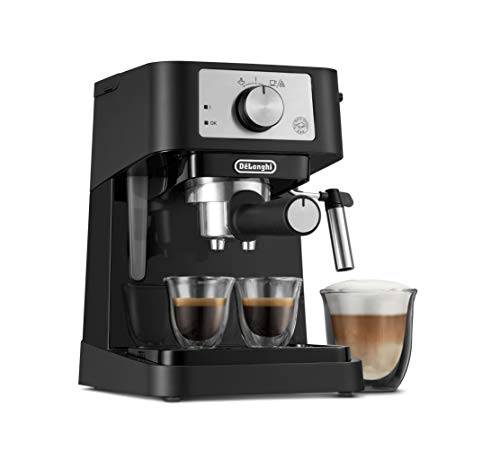
A small stainless steel boiler that keeps the group hot, simple insides that Lance Hedrick showed are easy to service, and plenty of steam once the panarello sleeve comes off. It is fully manual with a small shower screen, but a precision basket and a decent grinder take it a long way.
$149.95· as of Oct 27, 2026 Product prices and availability are accurate as of the date/time indicated and are subject to change. Any price and availability information displayed on Amazon.com at the time of purchase will apply to the purchase of this product.i
4Best Build If You Have the Height: Gaggia Classic Pro

Wider and taller than the rest, but the only machine-grade pick: 58mm portafilter, steel body, cheap parts and the best straight shots in two head-to-head tests. Its tank also fills from the front, which helps under low cabinets. Give it ten minutes to warm up.
$507.99· as of Oct 27, 2026 Product prices and availability are accurate as of the date/time indicated and are subject to change. Any price and availability information displayed on Amazon.com at the time of purchase will apply to the purchase of this product.i
The Short Answer
The best espresso machine for small kitchens depends on how many inches you can spare. Buy the Breville Bambino Plus if you have about 8 inches of counter and mostly drink lattes or cappuccinos. It is fast, it steams milk without supervision and it leaves room for a grinder beside it. Choose the De'Longhi Dedica Duo if you have closer to 6 inches and plan to use pre-ground coffee. The Stilosa is the budget route, and the Gaggia Classic Pro is for buyers who drink straight espresso, have a good grinder, and want a machine they can repair for a decade.
Best Espresso Machine for Small Kitchens: What Reviewers Say
| Machine | What reviewers praised | Most common complaint | Best for |
|---|---|---|---|
| Breville Bambino Plus | Ready in about 3 seconds, automatic milk with 3 temperatures and 3 foam levels, auto purge, dry pucks | Drip tray fills fast; first shot runs cool without a blank shot; light enough that it slides when you lock the portafilter | Milk drinkers who want minimal fuss |
| De'Longhi Dedica Duo | About 6 in wide, tamper and pitcher included, cold-extraction mode, finer steam tip than the old Dedica | Steam is fairly weak; touch controls take cup-warmer space | The narrowest counters and pre-ground coffee |
| De'Longhi Stilosa | Stainless boiler that heats the group, simple to service, strong steam once modded | Fully manual, small shower screen, cheap stock portafilter and tamper | Lowest budget, people who like to tinker |
| Gaggia Classic Pro | Best straight shots, steel body, 58mm basket, front-fill tank, repairable | Long warm-up, short and stiff steam wand, no automatic features | Straight-espresso drinkers who want longevity |
How We Chose
We built this guide from eight video reviews, all transcribed in full, plus their comment threads as a record of what owners report after months or years of use. The eight are Whole Latte Love's three-way comparison of the Bambino Plus, Gaggia Classic Pro and Dedica Arte; two reviews from Tom's Coffee Corner (a Bambino Plus test and a Stilosa vs Dedica vs ECP3420 comparison); Espresso Doc's Dedica vs Dedica Duo test; Lance Hedrick's Stilosa review; Lifestyle Lab's Bambino Plus vs Gaggia Classic Pro; Alternative Brewing's Bambino Plus review; and America's Test Kitchen's espresso machine roundup.
Not every source carries the same weight. Whole Latte Love and Alternative Brewing are both retailers that sell the machines they review, so we leaned on their measurements more than their opinions. Tom's Coffee Corner, Espresso Doc and Lifestyle Lab link to retailers in their descriptions, and Lifestyle Lab says on camera that its video is not sponsored. None of the eight was sponsored by a manufacturer. America's Test Kitchen tested none of our four picks directly; its findings inform the pod and all-in-one alternatives below. Where only one reviewer reports a number, we name them.
Measure the Whole Setup, Not Just the Machine
A machine that fits is only half of it. Unless you buy a pod machine, you also need a grinder, and most compact electric grinders take another 5 to 7 inches of counter. Six of the eight reviewers said in some form that the grinder limits your espresso more than the machine does. Before you buy, check three numbers:
- Width for machine plus grinder. The Dedica Duo and a slim grinder fit in about a foot. The Gaggia and a grinder need closer to 16 inches.
- Height under your wall cabinets. Upper cabinets usually sit about 18 inches above the counter. Alternative Brewing measured the Bambino Plus at about 31 cm (just over 12 inches) tall, and the Dedica is similar. The Gaggia and the Stilosa list at roughly 14 inches. Lifestyle Lab pointed out that the Gaggia's tank can be filled from the front as well as the top, so low cabinets matter less for it than the height suggests.
- Depth for the portafilter handle and drip tray. All of these are about a foot deep (Alternative Brewing measured the Bambino Plus at 32 cm). The handle sticks out further, so leave room to stand in front of it.
If your grinder has to live in a cupboard, the trade-off changes. Machines with pressurized baskets (all four of these include them) let you start on pre-ground coffee, which Whole Latte Love compared to chain-cafe espresso. Lifestyle Lab added a useful rule: on pre-ground coffee the Gaggia's espresso advantage largely disappears, so the Bambino Plus is the better buy. To get past that level you need fresh grinding, and our espresso grinder guide covers grinders that fit next to a small machine.
Breville Bambino Plus: The Default Pick for Small Counters
The Bambino Plus does more per inch than anything else here, and it is the machine with the most support across our sources: four full reviews, plus long comment threads from owners. Lifestyle Lab compared its footprint to a typical pod machine. Alternative Brewing measured it at about 19.5 cm wide, 32 cm deep and 31 cm tall, with a 1.9 litre removable tank that is larger than the base Bambino's.
Its ThermoJet heater is ready in about three seconds, so there is no reason to leave it switched on. The reviewers agreed on the strengths: a three-way solenoid valve that leaves dry pucks, single and double buttons you can program, and automatic milk texturing that you choose from three temperatures and three foam levels before the wand stops itself using a sensor in the drip tray. It purges the wand automatically when you lower it. Lifestyle Lab timed the automatic steam at about 38 seconds for one drink and noted you can clean up or prep the next shot while it runs. Alternative Brewing got its best milk on the middle and upper settings with the jug pushed all the way back on the sensor.
Tom's Coffee Corner called the four-hole steam tip very powerful but found the automatic mode a little inconsistent, sometimes making the foam too thick. He also measured brew temperature at roughly 90 to 92°C. That suits medium and dark roasts, but he would not recommend it for light roasts.
Two quirks come up again and again. First, the water heats faster than the metal: Alternative Brewing called a blank shot through the empty portafilter almost mandatory to warm the group, portafilter and cup, and owners in the comments say the same. Second, the machine is so light that both Lifestyle Lab and Alternative Brewing hold the top with one hand while locking in the portafilter.
The daily friction is the drip tray. Between the auto purge and the solenoid it fills quickly, and Alternative Brewing suggests emptying it every couple of drinks. Several owners purge the wand into the empty milk jug instead. Whole Latte Love found no cup warming at all and noted that the 54mm basket limits dose (owners say aftermarket 18 to 22 g baskets fit). Its other worry was that the automatic features add parts that could fail, and a handful of commenters do report leaks or water that runs less hot after a few years. They are outnumbered, though, by owners in the Alternative Brewing and Lifestyle Lab threads reporting three to seven years of daily use.
Tom also pointed out a hidden hot-water function: press the lower-right button and the one-cup button together. It is warm enough for an Americano, though not kettle-hot.
Check the Bambino Plus price on AmazonDe'Longhi Dedica Duo: For the Narrowest Counters
At about 15 cm (6 inches) wide and around 10 pounds, the Dedica is the model reviewers name first when space is the constraint. Tom's Coffee Corner rated the original Dedica the clear winner of his De'Longhi test on ergonomics and partner acceptance, and the easiest to travel with. The Duo is the 2025 update. Espresso Doc ran both and found the espresso essentially the same, so the case for the Duo rests on what comes in the box:
- A proper tamper and a milk pitcher, where the original came with a plastic scoop that doubles as a tamper.
- A cold-extraction mode that makes an iced-coffee base in about five minutes.
- A steam tip with a smaller hole, which gave Espresso Doc much better control over microfoam than the original's wide tip.
The trade-offs are modest. Espresso Doc preferred the original's physical buttons over the Duo's touch panel, which also cuts the cup warmer from three cups to two. He found the steam power fairly weak and the thermoblock temperature varied from shot to shot. Like every Dedica, it uses 51mm pressurized baskets and has no three-way valve. Whole Latte Love saw that as messy pucks, while Tom argued the opposite: the puck stays intact and drops out cleanly. None of the four newer reviews in our set covered the Dedica, so this pick still rests on three sources.
If coffee comes out lukewarm, which is a common complaint in the comments, owners suggest choosing the highest of the three temperature settings and running water through the portafilter and cup first. Descaling matters on thermoblocks too, and our De'Longhi descaling guide walks through the Dedica's alert.
See the Dedica Duo on AmazonDe'Longhi Stilosa: The Budget Boiler
The Stilosa is wider than the Dedica, but it has something the Dedica lacks: a small boiler connected to the group, which keeps the brew head hot. Lance Hedrick, who usually starts his recommendations at more expensive machines, bought one and came away a convert. He opened it on camera to show a stainless steel boiler, a standard vibratory pump and very little else, which makes it easy to service and keep out of landfill.
In Tom's Coffee Corner's side-by-side test it took 1 to 1.5 minutes to heat, and the boiler machines improved further when left on for about 20 minutes. With an improvised probe, Lance saw brew water climb to roughly 90 to 93°C and then fall away as the small boiler refilled, a declining profile he actually likes. He lowers the temperature for dark roasts by running water until the ready light goes off, and raises it with a few seconds in steam mode. Once Tom removed the panarello sleeve and zip-tied the hose, he found the steam pressure more than enough for creamy milk.
The limits are real. It is fully manual, so you start and stop every shot yourself. Both reviewers wished the shower screen were larger: Tom measured it at about 42mm against roughly 50mm on the Dedica, which is the main reason he preferred the slightly larger ECP3420 from the same family. Lance works around it with a puck screen. The stock accessories are poor, with a plastic-lined portafilter and a plastic scoop that doubles as a tamper, and the steam valve and steam tube are plastic. The drip tray makes it hard to fit a scale under the cup, and after steaming you need to run water to cool the boiler before pulling another shot. Tom also measured De'Longhi's "15 bar" pumps topping out at 11 to 12 bar against a blind basket, with a properly ground puck sitting around 8 to 9, so the number on the box is not a concern.
Lance's upgrade order was a precision basket (which let him dose 17 to 18 g), a solid tamper and a puck screen, and with those plus a capable grinder he pulled a light roast he was happy with. Owners in both threads describe the same path, often with a budget hand grinder. Two warnings recur: if you depressurize the stock basket, its bottom plate can bow after a choked shot, and third-party portafilters can leak at the gasket unless you lock them in more firmly than the stock one.
Check the Stilosa's price on AmazonGaggia Classic Pro: Small Footprint, Big Ceiling
The Gaggia is the odd one out. It is about 9.5 inches wide and 14 inches tall, so measure your cabinet clearance first. Lifestyle Lab noted two upsides of that size: the extra weight keeps it planted when you lock in the portafilter, and the tank fills from the front, so you don't have to slide it out from under a cabinet. It is also the only machine-grade option here. Whole Latte Love described thick steel panels, an all-metal frame, cheap parts and easy repairs, and noted that it is hand-assembled in Italy while the appliance-grade machines are made in China.
The boiler warms the group and the chrome-plated brass portafilter, which helps both shot temperature and cup temperature (Whole Latte Love measured about 130°F on its cup warmer, against roughly 103°F on the Dedica). It takes 18 g in the stock basket and larger baskets after that. Using the same grinder and coffee, Lifestyle Lab found it pulled better shots than the Bambino Plus once dialed in, and called it the best pure espresso machine in its class.
Milk is where the two head-to-heads split. Whole Latte Love had it steaming 5 oz of cold milk in about 25 seconds, the fastest of its three machines. Lifestyle Lab agreed it has slightly more power (about 30 seconds per drink against 38 on the Bambino Plus) but found you wait around 35 seconds after a shot before the steam is ready, and named the short, stiff, cheap-feeling steam arm as its single biggest complaint. If you mostly drink lattes, both that reviewer and many commenters point you to the Bambino Plus instead.
The cost is time and technique. Whole Latte Love recommends switching it on at least ten minutes ahead with the portafilter locked in. Commenters mention "temperature surfing" to get consistent shots, and some fit a 9-bar spring. There is no automatic milk and no programmable shot. One commenter put the choice plainly: get the Gaggia if you want a challenge, and the Bambino Plus if you want quick, reliable lattes.
Note that the current Amazon listing is the Classic Evo Pro (RI9380), the updated version of the model Whole Latte Love reviewed. Lifestyle Lab says its conclusions apply to both versions.
View the Gaggia Classic Pro on AmazonBuying Guide: What Matters in a Tight Kitchen
Heat-up time. On a small counter you probably unplug or switch off between uses. Thermoblocks (Bambino Plus, Dedica Duo) are ready in seconds to about 30 seconds, though a blank shot helps the first espresso. Boiler machines (Stilosa, Gaggia) need minutes, and longer for their best shots. If you make one drink before work, that difference matters more than any spec on the box.
Tank access. Check where the tank comes out before you check its size. Under low cabinets, a rear tank you lift out from the top means sliding the machine forward each time. The Gaggia's front fill avoids that.
Basket size. The 51mm De'Longhi and 54mm Breville baskets cap your dose, and the Dedica comes with pressurized baskets only. If you plan to grind fresh and learn properly, the Bambino Plus and the Gaggia both take unpressurized baskets, and the Stilosa's stock basket can be depressurized.
Milk. If you drink lattes and don't want to learn steaming, the Bambino Plus is the only one that does it for you. The De'Longhi machines all improve with a cheap single-hole steam tip or the zip-tie trick, a fix both Tom's Coffee Corner and Espresso Doc showed.
Repair or replace. Commenters point out that appliance-grade machines are rarely worth repairing once out of warranty, and Whole Latte Love made the same case for the Gaggia. Lance Hedrick's teardown adds a nuance: the Stilosa is simple enough that a confident owner can fix it too. The Gaggia is still the one built to last, with the widest choice of parts.
Also Considered
- Breville Bambino. The non-Plus version is even narrower, at about 6.3 inches wide on its Amazon listing, but has a manual steam wand and a smaller tank. One commenter notes it lacks the Plus's three-way valve. Our Bambino vs Bambino Plus comparison and Bambino review cover it in detail. Check the Bambino on Amazon
- Nespresso Essenza Mini. If you will not grind at all, this pod machine is about 4.3 inches wide. America's Test Kitchen's pick in this class was its sibling, the Pixie: the tester liked the convenience but found the shots heavy on crema and thin in body, and noted that pods cost far more per pound than beans. Commenters were blunter. See our Essenza Mini review. See the Essenza Mini on Amazon
- Gaggia Magenta Prestige. America's Test Kitchen's super-automatic pick grinds, brews and froths milk in one box, and the tester called it compact for its type. It is bigger than anything above, but it replaces both the machine and the grinder. Our espresso machines with a grinder guide compares it with other all-in-ones.
- De'Longhi ECP3420. Tom's Coffee Corner's value winner for espresso and steam, with a larger shower screen than the Stilosa, though it is not as slim as the Dedica. It is not one of our picks, so it isn't linked here.
- Original Dedica (EC685). Same espresso as the Duo, according to Espresso Doc. It is only worth it at a deep discount, and you'll want a new steam tip.
Frequently Asked Questions
What is the smallest espresso machine with a steam wand?
Of the machines reviewers tested, the De'Longhi Dedica family is the slimmest at about 6 inches wide. The Breville Bambino is close behind at about 6.3 inches. Both have a real steam wand, unlike most pod machines.
Will an espresso machine fit under kitchen cabinets?
Most compact machines will. The Bambino Plus and the Dedica Duo are about 12 inches tall. The Gaggia Classic Pro and the Stilosa list at roughly 14 inches, which fits under a standard 18-inch gap. The Gaggia's tank also fills from the front, while machines that refill from the top or the back may need sliding forward each time.
Is the Bambino Plus or the Dedica Duo better for a small kitchen?
The Bambino Plus, if you can spare the extra 2 inches of width. It has stronger steam, automatic milk, dry pucks and accepts unpressurized baskets. The Dedica Duo wins only when width is the hard limit or you want its cold-extraction mode for iced drinks.
Is the Gaggia Classic Pro worth it if I mostly drink lattes?
Probably not. Lifestyle Lab found the Gaggia makes the better straight shot, but in a large milk drink that difference shrinks, and the Bambino Plus steams faster after brewing and does it hands-free. Pick the Gaggia if you drink espresso on its own and have a good grinder.
Do I need a separate grinder?
Not to start: all four machines include pressurized baskets that work with pre-ground coffee. Reviewers agree that a grinder is the biggest upgrade, though, so leave space for one. If two appliances won't fit, see our guide to the best espresso machines with a grinder or the all-in-one picks in our espresso machines for beginners guide.
Is a Nespresso a good choice for a tiny kitchen?
It is the smallest and least messy option, and it needs no grinder. But it makes capsule coffee, not espresso you can dial in. America's Test Kitchen found pod shots thin-bodied and expensive per pound, and its commenters were quick to agree. Choose it for convenience, not for espresso quality.
The Verdict
For most small kitchens, the Breville Bambino Plus is the right call. It is small enough to leave room for a grinder, quick enough to switch off between drinks, and the only pick that textures milk on its own. Go with the Dedica Duo if you have 6 inches rather than 8 and plan to use pre-ground coffee, and the Stilosa if budget matters most and you enjoy tinkering. The Gaggia Classic Pro is the long-term buy for straight-espresso drinkers, as long as your counter has the height for it and you don't mind waiting ten minutes to brew. For bigger budgets, see our espresso machines under $500 or browse every espresso guide.
Sources
- Whole Latte Love: Compare: Breville Bambino Plus, Gaggia Classic and Delonghi Dedica Arte Espresso Machines (retailer)
- Tom's Coffee Corner: Sage (Breville) Bambino Plus Home Espresso Machine Review & Test
- Tom's Coffee Corner: Delonghi's Best Budget Home Espresso Machines: Stilosa vs Dedica vs ECP 3420
- Espresso Doc: Delonghi Dedica vs Dedica Duo: What's New and Is It Worth It?
- Lance Hedrick: Delonghi Stilosa: An Unbelievable Value
- Lifestyle Lab: Breville Bambino Plus vs Gaggia Classic Pro
- Alternative Brewing: Breville Bambino Plus: The Honest Truth About This Espresso Machine (retailer)
- America's Test Kitchen: Best Espresso Machines (Beginner to Advanced)