Best Espresso Machines for Beginners (2026)
Researched by Netspresso Editorial · Published Jun 3, 2026
The best espresso machine for beginners is the Breville Barista Express — it combines a built-in conical burr grinder with a capable espresso engine, so you have everything you need in one box. If you already have a grinder (or plan to buy one separately), the Bambino delivers the same Breville quality in a smaller, simpler package. On a tight budget, the De'Longhi Stilosa is the most affordable way to learn the basics of pulling a real espresso shot.
| Pick | Machine | Rating | Buy |
|---|---|---|---|
| Best All-in-One | Breville Barista Express | 4.5 | Check Price → |
| Best Simple Start | Breville Bambino | 4.5 | Check Price → |
| Best Budget | De'Longhi Stilosa | 4 | Check Price → |
1Best All-in-One: Breville Barista Express

Built-in conical burr grinder means one purchase covers everything you need for fresh-ground espresso at home.
$688.99· as of Oct 27, 2026 Product prices and availability are accurate as of the date/time indicated and are subject to change. Any price and availability information displayed on Amazon.com at the time of purchase will apply to the purchase of this product.i
2Best Simple Start: Breville Bambino
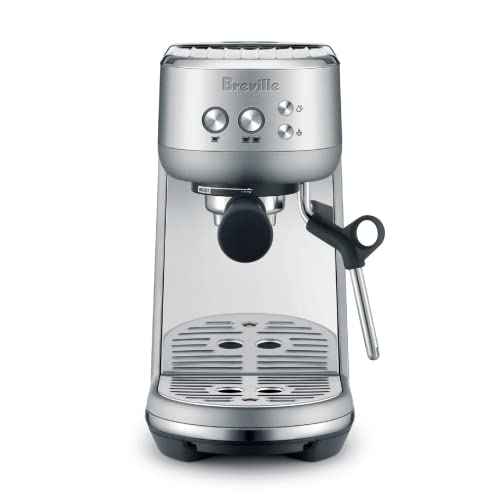
ThermoJet heating and automatic pre-infusion deliver consistently great shots in a tiny, approachable machine.
$299.95· as of Oct 27, 2026 Product prices and availability are accurate as of the date/time indicated and are subject to change. Any price and availability information displayed on Amazon.com at the time of purchase will apply to the purchase of this product.i
3Best Budget: De'Longhi Stilosa
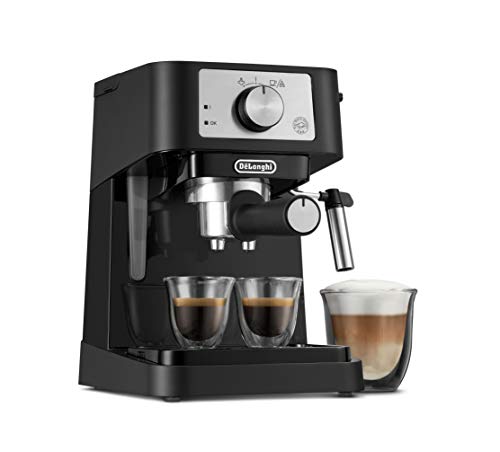
At around $100, it is the most affordable entry point into real 15-bar espresso extraction.
$149.95· as of Oct 27, 2026 Product prices and availability are accurate as of the date/time indicated and are subject to change. Any price and availability information displayed on Amazon.com at the time of purchase will apply to the purchase of this product.i
The Short Answer
If this is your first espresso machine and you want to keep things simple, buy the Breville Barista Express. It has a conical burr grinder built in, so you are not juggling two pieces of equipment right away, and it pulls consistently good shots without demanding barista-level technique. The Bambino is the better pick if you like the idea of a smaller machine and do not mind sourcing a grinder separately. The Stilosa is for budget-first shoppers who want to learn espresso fundamentals before committing to more hardware.
All three machines work well for beginners — they differ mainly in how much of the workflow they handle for you, and how much you are willing to spend upfront. If you are also exploring options in the mid-range price band, see our guide to the best espresso machines under $500.
What Actually Makes a Machine Beginner-Friendly?
Before diving into the picks, it is worth spelling out what separates beginner-friendly machines from prosumer gear that will punish every small mistake.
Stable pressure and temperature
Espresso extracts at around 9 bar. Budget machines often advertise 15 bar but deliver inconsistent pressure throughout the shot, which produces sour, bitter, or weak results. A quality beginner machine holds pressure and temperature steady from the first second to the last, giving you repeatable results as you learn. Look for PID temperature control where possible — it takes one variable completely out of your hands.
Forgiving workflow
Machines with pressurized (dual-wall) baskets compensate for imperfect grind size and inconsistent tamping — two skills beginners are still developing. They produce a reasonably good shot even when technique is rough. Single-wall baskets are more transparent, but they require a dialled-in grinder and consistent tamping to work well. Our three picks cover both ends of this spectrum.
Integrated or compatible grinder
The grinder matters as much as the machine itself. Grinding fresh is non-negotiable for real espresso — pre-ground coffee goes stale in minutes after the bag is open. All-in-one machines like the Barista Express include a grinder, reducing the learning curve and total cost. Machines like the Bambino and Stilosa require a separate grinder, which adds expense but also flexibility to upgrade later.
Easy cleaning
Descaling, back-flushing, and wiping steam wands are daily and weekly tasks. Machines with removable drip trays, accessible group heads, and clear cleaning alerts are far easier to maintain. Skipping cleaning leads to bitter shots and shortened machine life — something worth checking in our guide to bitter espresso.
Our Beginner Picks in Depth
Breville Barista Express — Best All-in-One
The Barista Express (model BES870XL) is the machine most coffee educators recommend for beginners who want a single-purchase solution. The built-in conical burr grinder has 16 grind settings and drops grounds directly into a 54mm portafilter sitting in a cradle — no extra weighing or transferring required. The 1600-watt ThermoCoil heating system reaches extraction temperature quickly, and a low-pressure pre-infusion stage gradually saturates the puck before the full pressure hits, which minimises channelling for beginners who are still learning to tamp evenly.
The 67 oz water tank and 8 oz bean hopper are generously sized for daily home use. Two included double-wall baskets are ideal while you develop your technique, and you can switch to single-wall precision baskets later as your skills improve. The steam wand is a 360-degree swivel commercial-style unit — capable enough to texture milk for lattes and cappuccinos without being fiddly.
The honest caveat: the built-in grinder, while convenient, is not as precise as a dedicated burr grinder at the same price point. If you eventually want to chase competition-level extraction, you will outgrow it. For the first year or two of the espresso journey, though, it is more than good enough — and it spares you the cost and counter space of a second appliance.
Read our full Breville Barista Express review for a deeper look at shot quality, grinder performance, and long-term durability.
Best for: First-time buyers who want everything in one box, minimise counter space, and do not want to research grinders yet.
Breville Bambino — Best Simple Start
The Bambino (BES450BSS) strips everything back to the essentials. It is one of the smallest espresso machines in Breville's lineup, but it does not sacrifice the core technology: ThermoJet heating brings water to extraction temperature in about 3 seconds, PID temperature control keeps shots consistent, and low-pressure pre-infusion is included by default. At 54mm portafilter, it shares Breville's standard basket size, so accessories and upgrade baskets are easy to find.
The Bambino's simplicity is genuinely beginner-friendly in a different way from the Barista Express. There are fewer settings to get lost in, the footprint is noticeably smaller, and the workflow is predictable: grind, dose, tamp, lock in, press the button. Beginners who find the Barista Express's grinder settings and options overwhelming sometimes prefer the Bambino's stripped-back interface.
The trade-off is that you need a grinder. A budget conical burr grinder will add $50–$150 to your total cost. That said, buying a separate grinder gives you the flexibility to upgrade either component independently as your skills and tastes evolve — a genuine long-term advantage.
See our full Breville Bambino review for more on the steam wand, cleaning routine, and shot consistency.
Best for: Beginners who have (or plan to buy) a grinder, want a small machine, or prefer a no-fuss workflow without dialling in grinder settings on the machine itself.
De'Longhi Stilosa — Best Budget
The Stilosa (EC260BK) costs around $100 and is the only machine in our lineup that most people would call truly affordable. It uses a stainless steel single boiler and a 15-bar pump — the fundamentals for real espresso — and includes a manual milk frother steam wand for lattes and cappuccinos. The 35 oz water tank is smaller than the Breville options but adequate for a one-to-two-person household. The removable drip tray makes daily cleaning manageable.
What the Stilosa does not have: PID temperature control, automatic pre-infusion, or a grinder. It is a genuinely manual machine, which means your results will depend more directly on your technique and your grinder quality than with the Breville options. Beginners can absolutely learn on this machine, and many do — the low price means you are not out a lot of money if espresso turns out not to be for you. But expect the learning curve to be steeper: tamping pressure and grind size both matter more here, and poor technique will show up immediately in the cup.
The 51mm portafilter is slightly smaller than the 54mm Breville standard, which limits basket selection somewhat. That is a minor concern for most beginners.
Best for: Budget-conscious shoppers, those trying espresso for the first time before committing to a higher spend, or anyone who wants to learn the basics before upgrading.
All-in-One vs. Separate Grinder: Which Should You Choose?
This is the most common question beginners ask, and the honest answer depends on your budget and how deep you plan to go.
Choose an all-in-one (Barista Express) if:
- You want one purchase to cover everything
- Counter space is limited and a second appliance would bother you
- You are not yet sure how far down the espresso rabbit hole you will go
- You want to reduce the number of variables while you learn
Choose a machine plus separate grinder (Bambino + grinder) if:
- You already own a capable burr grinder
- You are likely to upgrade components over time
- You prefer a simpler machine with fewer settings
- You want the flexibility to use one grinder for multiple brew methods (pour-over, drip, etc.)
One note worth flagging: the grinder is arguably the single most important factor in espresso quality. A modest machine paired with a good burr grinder will consistently outperform an expensive machine paired with a blade grinder or stale pre-ground coffee. Budget accordingly if you go the separates route.
For context on the /espresso category broadly, there are machines at every price tier — but these three represent the clearest beginner on-ramps in 2026.
Frequently Asked Questions
Do I need to grind my own beans?
Yes — for espresso, fresh grinding makes a significant difference. Espresso uses very fine grinds with a large surface area, which means the coffee degrades quickly once ground. Pre-ground espresso coffee sold in bags loses much of its flavour within days of opening. If you buy a Bambino or Stilosa, budget for a grinder at the same time. The Barista Express has one built in.
Automatic vs. manual espresso machines — what is the difference?
"Automatic" in home espresso usually means the machine controls the water volume: press a button, and it stops pulling when the programmed dose is reached. "Manual" means you control the brew by holding the button or lever yourself. For beginners, a semi-automatic or automatic machine (like all three picks here) is the easier starting point. True manual lever machines require a lot of practice to use well.
How much should a beginner spend on an espresso machine?
Somewhere between $100 and $700 covers the beginner tier. At the low end ($100–$150), the Stilosa gives you real espresso for minimum investment. In the $250–$350 range, the Bambino adds consistent temperature control and a more refined workflow. The Barista Express at around $700 is the top of the beginner tier — after that, you are buying into prosumer hardware that rewards technique you are still developing. Most beginners find the $300–$700 range the sweet spot: capable enough to pull genuinely good shots, forgiving enough to learn on.
When should I upgrade from a beginner machine?
Upgrade when the machine becomes the bottleneck — when your technique is consistent, your grinder is dialled in, and you can tell the shots could be better but the machine is holding you back. For most people this takes one to three years. If your shots are inconsistent right now, the machine is almost never the reason; technique and grind are far more common culprits. Check our guide on why your espresso tastes bitter before assuming you need new hardware.
Does the Breville Bambino Plus make more sense for beginners than the Bambino?
The Bambino Plus adds an automatic milk texturing feature — it froths milk to a set temperature at the press of a button. If you plan to make a lot of lattes and flat whites without wanting to learn manual steaming, it is worth the extra cost. For pure espresso beginners who want to learn the full workflow, the standard Bambino is sufficient.