Best Espresso Machines Under $500 (2026)
Researched by Netspresso Editorial · Published Jun 3, 2026
The best espresso machines under $500 can pull genuinely café-quality shots — but the right pick depends on how hands-on you want to be. Our top overall choice is the Gaggia Classic Pro: a 58mm commercial portafilter, three-way solenoid valve, and Italian build quality that can last two decades. Note that all prices should be verified before purchase, as availability and pricing fluctuate.
| Pick | Machine | Rating | Buy |
|---|---|---|---|
| Best Overall | Gaggia Classic Pro | 4.5 | Check Price → |
| Best Compact | Breville Bambino | 4.5 | Check Price → |
| Best Budget | De'Longhi Stilosa | 4 | Check Price → |
1Best Overall: Gaggia Classic Pro

A commercial 58mm portafilter and brass boiler give the Gaggia a path to world-class espresso that most machines at twice the price can't match.
$507.99· as of Oct 27, 2026 Product prices and availability are accurate as of the date/time indicated and are subject to change. Any price and availability information displayed on Amazon.com at the time of purchase will apply to the purchase of this product.i
2Best Compact: Breville Bambino
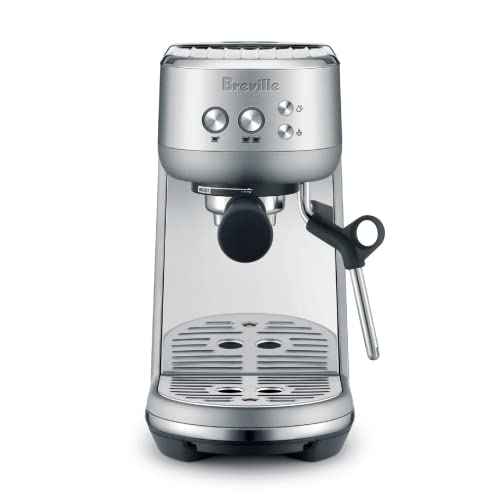
ThermoJet technology heats up in 3 seconds, and its small footprint makes it the easiest way to get great espresso in a tight kitchen.
$299.95· as of Oct 27, 2026 Product prices and availability are accurate as of the date/time indicated and are subject to change. Any price and availability information displayed on Amazon.com at the time of purchase will apply to the purchase of this product.i
3Best Budget: De'Longhi Stilosa
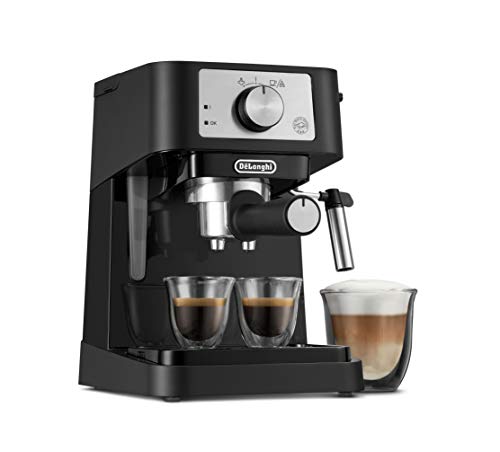
The Stilosa proves you don't need to spend $300+ to pull respectable espresso shots and steam real microfoam.
$149.95· as of Oct 27, 2026 Product prices and availability are accurate as of the date/time indicated and are subject to change. Any price and availability information displayed on Amazon.com at the time of purchase will apply to the purchase of this product.i
Who This Guide Is For
If you want real espresso — not the watered-down approximation that drip machines and pod systems produce — and you have up to $500 to spend, you are in a genuinely good place. The machines in this guide pull shots through proper 9-bar pump pressure, accept standard espresso baskets, and give you the feedback loop you need to actually improve as a home barista.
Our top pick for most people is the Gaggia Classic Pro. Its 58mm commercial portafilter, three-way solenoid valve, and durable build give it a ceiling that will outlast your skill development by years. If counter space is tight or you want something quicker to learn, the Breville Bambino is the smarter buy. On a strict budget, the De'Longhi Stilosa is the honest entry point.
One caveat applies to all three: none of these machines includes a grinder, and the grinder matters more than the machine itself. Budget $150–200 for a dedicated burr grinder alongside whichever machine you choose — more on that below.
For a broader look at machines suited to new home baristas, see our best espresso machines for beginners guide.
How We Picked: What Actually Matters Under $500
The sub-$500 espresso market has become surprisingly capable, but not all machines are equivalent. Here is what separates a worthwhile buy from a marketing exercise.
Portafilter size
A 58mm portafilter is the industry standard used by most commercial espresso machines. Why does it matter at home? Larger basket diameter means more even water distribution across your coffee puck, which translates directly to more consistent extraction. The Gaggia Classic Pro uses a full 58mm portafilter — the same size as professional café equipment. The Breville Bambino uses a 54mm portafilter, which is proprietary to Breville but still meaningfully larger than the 51mm found on budget machines like the Stilosa. A smaller portafilter is not disqualifying at this price, but a 58mm basket gives you more room to experiment with dose and technique.
Boiler type
Under $500, you will encounter three heating technologies: traditional boilers, thermoblock systems, and Breville's ThermoJet. Traditional single boilers (Gaggia, Stilosa) maintain water at a set temperature and require a warm-up period — typically 5–10 minutes — before brewing. Thermoblock systems heat water on demand but can produce inconsistent temperatures. Breville's ThermoJet is a refined on-demand heater that reaches extraction temperature in approximately 3 seconds, delivering faster ready times than a traditional boiler. The trade-off is that the grouphead and portafilter are cold on startup, so a brief pre-flush or pre-heat is worthwhile for best results.
Three-way solenoid valve
This small component is worth looking for at any price. It releases pressure from the group head immediately after extraction, allowing you to remove the portafilter without a wet, pressurized spray of coffee. Both the Gaggia Classic Pro and Breville Bambino include it; the Stilosa does not at its price point. It also produces a dry puck that is easier to knock out and reduces wear on your basket.
Grinder or not
None of the machines in this guide include a built-in grinder. This is actually the right trade-off: a machine that sacrifices build quality to bundle in a mediocre grinder is a worse deal than buying them separately. A good burr grinder paired with a modest machine will produce better espresso than a great machine paired with a blade grinder or pre-ground coffee. See the grinder section at the end of this guide.
Build quality and longevity
At this price tier, stainless steel and brass components signal a machine designed to last. The Gaggia Classic Pro is built in Italy with a stainless steel housing and has a decades-long reputation for reliability. The Breville Bambino is well-made for its price but uses more plastic in its construction. The Stilosa is largely plastic and is priced accordingly — it is a starter machine, not a long-term investment.
The Picks: Deeper Rationale
The comparison table and buy boxes above give you the quick specs. Here is the context behind each choice.
Gaggia Classic Pro — Best Overall
The Gaggia Classic Pro occupies a unique position in the espresso machine market: it is genuinely good enough that upgrading the user's technique and grinder — not the machine — becomes the limiting factor for years. The 58mm commercial portafilter means aftermarket baskets, tampers, and accessories fit without adapters. The three-way solenoid valve keeps the workflow clean. The brass boiler provides thermal stability that pressurized portafilter machines cannot match.
The honest limitation: the Gaggia Classic Pro does not have a PID temperature controller from the factory. Water temperature is regulated by a pressure stat, and you may encounter slight shot-to-shot temperature variation until you learn the machine's warm-up rhythm — or until you add a third-party PID kit (approximately $50–80). Many owners add one within the first year. This is a manageable quirk, not a dealbreaker, but it is something to know going in.
The machine also requires you to switch between brew mode and steam mode and wait for the boiler to re-heat — typically 30–60 seconds — before steaming milk. This single-boiler workflow is slower than dual-boiler machines, which cost considerably more.
For more on how it brews day to day, see our full Breville Bambino review for comparison context on what a more automated workflow looks like.
Breville Bambino — Best Compact
The Bambino is the right answer for anyone who wants excellent espresso without a learning curve measured in months. Its 3-second heat-up time is not marketing language — it genuinely means you can go from pressing the button to pulling a shot in under a minute, which is a meaningfully different morning experience than waiting for a traditional boiler.
The 54mm portafilter is Breville's own standard, and while third-party accessories are less plentiful than for 58mm machines, Breville's own basket upgrades are readily available. Pre-infusion is built in, which gently wets the puck before full pressure extraction and reduces channeling — a problem that beginners encounter frequently with their tamping technique.
The trade-off is the machine's ceiling. The Bambino is highly capable, but its automation and ThermoJet design mean there is less for an advanced home barista to tune. If your goal is to spend years dialing in extraction variables, the Gaggia Classic Pro's manual character is more rewarding. If your goal is consistently good espresso every morning with minimal fuss, the Bambino wins.
For a detailed breakdown of this machine's day-to-day performance, see our full Breville Bambino review.
De'Longhi Stilosa — Best Budget
The Stilosa is the machine to recommend when the conversation starts with "I'm not sure I'll stick with espresso long-term." At roughly $100–150, it costs less than a month of café espresso drinks, and it is capable enough to tell you whether you actually enjoy the home barista process before you commit to a $400+ setup.
What makes the Stilosa better than other machines at its price is its traditional stainless steel steam wand rather than a Panarello attachment. A Panarello (the pressurized, aerating steam tip found on many cheap machines) produces froth but not true microfoam — it teaches bad habits if you ever want to learn latte art or move to a better machine. The Stilosa's wand requires technique, which means the skills you develop on it transfer directly to more capable equipment.
The limitations are real: 51mm portafilter, no solenoid valve, largely plastic construction, and no PID. Shot-to-shot consistency requires patience and attention. But for the price, it is a legitimate espresso machine, not a toy.
What You Give Up Under $500
Being honest about this tier's limits is part of serving you well.
No dual boiler. Every machine here uses a single boiler, which means you cannot brew espresso and steam milk simultaneously. The workflow is always: pull shot, switch to steam, wait, then froth. This adds 30–90 seconds to milk-based drinks compared to a dual-boiler or heat-exchanger machine.
No built-in PID on the Gaggia. The Bambino does have electronic temperature control; the Gaggia does not from the factory. If precise temperature management matters to you from day one, either budget for a PID mod or choose the Bambino.
Portafilter size limitations. The 58mm portafilter on the Gaggia is excellent; the 54mm on the Bambino is good; the 51mm on the Stilosa is limiting. Basket upgrades and precision baskets are harder to find for smaller diameters.
Build-quality compromises. At $300 and below, you will encounter plastic components and lighter construction. These machines can last years with care, but they will not approach the longevity of the Gaggia's Italian metal construction.
No pressure profiling. Machines above $1,000 often allow you to vary pump pressure throughout extraction for nuanced flavor development. Everything in this guide operates at fixed pump pressure.
Frequently Asked Questions
Do I need a separate grinder?
Yes — this is not optional if you want good espresso. Pre-ground coffee goes stale within hours of grinding, and blade grinders produce inconsistent particle sizes that cause channeling and uneven extraction. The machines in this guide are capable of producing excellent espresso only when paired with a quality burr grinder.
Our recommendation is the Baratza Encore ESP (approximately $200), which offers 40 stepped grind settings across the espresso and filter range. It pairs well with all three machines in this guide. See our full Baratza Encore review for a detailed look. If your total budget is $500, consider allocating $150 to a grinder and $350 to a machine — that combination will outperform a $500 machine with a cheap grinder.
For manual grinder options and other alternatives, the espresso hub has a full grinder pairing section.
Is a single boiler enough for milk drinks?
For most home users, yes. The workflow — pull shot, switch to steam, wait briefly, froth milk — takes 2–3 minutes total and becomes second nature quickly. Where it matters most is if you are making multiple milk drinks in a row, such as for a family or guests. In that case, the switching time accumulates. A dual-boiler machine removes this friction entirely, but those start around $800–1,000.
What espresso-to-water ratio should I target?
The standard starting point for espresso is a 1:2 ratio — 18 grams of ground coffee yielding 36 grams of liquid espresso in 25–30 seconds. This is a baseline, not a rule; taste is the final arbiter. For a deeper explanation of how ratio affects flavor, see our espresso-to-water ratio guide.
Can I use pods or capsules with these machines?
None of the machines in this guide are designed for Nespresso or Keurig capsules. They use standard portafilters and loose ground coffee. Some machines support ESE (Easy Serving Espresso) pods — a flat, pre-measured coffee disc that fits in the portafilter — but pod use generally produces inferior results compared to freshly ground coffee and is not recommended if espresso quality is the goal.
How long will these machines last?
The Gaggia Classic Pro is built to last 15–20+ years with normal maintenance (periodic descaling, occasional gasket replacement). The Breville Bambino, being newer to market and more electronics-dependent, has a shorter track record but is generally considered durable for 5–10 years. The De'Longhi Stilosa, given its price and construction, should be treated as a 2–5 year machine. Descaling every 2–3 months is the single most important maintenance step for any of them.
Where should I learn more about dialing in espresso?
The espresso hub on this site covers grinder pairing, extraction theory, and technique guides. If you are completely new to the process, our best espresso machines for beginners guide walks through the learning curve in more detail before you commit to a machine.