Best Drip & Pour-Over Coffee Makers (2026)
Researched by Netspresso Editorial · Published Jun 3, 2026
The best drip coffee makers brew at 195–205°F, saturate grounds evenly, and hold their temperature without scorching — a combination only a handful of machines actually deliver. If you want hands-off convenience, the SCA-certified Technivorm Moccamaster is the gold-standard automatic pick; if you want maximum control and are willing to put in a few minutes of active effort, the Hario V60 manual pour-over is the most rewarding brew method under $30.
| Pick | Machine | Rating | Buy |
|---|---|---|---|
| Best Overall | Technivorm Moccamaster KBGV Select | 4.7 | Check Price → |
| Best Value | OXO Brew 9-Cup Coffee Maker | 4.5 | Check Price → |
| Best Pour-Over | Hario V60 (Size 02) | 4.6 | Check Price → |
1Best Overall: Technivorm Moccamaster KBGV Select

Handmade in the Netherlands, SCA-certified for both half and full carafes, and backed by a five-year warranty, the Moccamaster sets the benchmark every other automatic drip maker is measured against.
$369.00· as of Oct 27, 2026 Product prices and availability are accurate as of the date/time indicated and are subject to change. Any price and availability information displayed on Amazon.com at the time of purchase will apply to the purchase of this product.i
2Best Value: OXO Brew 9-Cup Coffee Maker
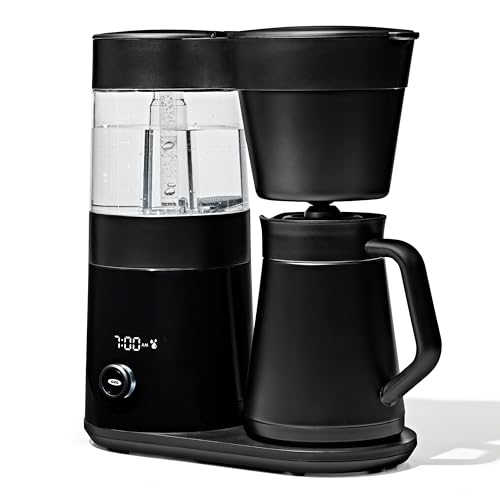
The OXO Brew 9-Cup delivers the same SCA Golden Cup compliance as machines costing far more, at roughly half the Moccamaster's price, thanks to its precision rainmaker showerhead and double-wall thermal carafe.
$207.18· as of Oct 27, 2026 Product prices and availability are accurate as of the date/time indicated and are subject to change. Any price and availability information displayed on Amazon.com at the time of purchase will apply to the purchase of this product.i
3Best Pour-Over: Hario V60 (Size 02)

The V60's 60-degree cone and spiral ribs give you unmatched control over flow rate and extraction — the purist's choice for anyone willing to trade automation for flavor clarity.
$25.00· as of Oct 27, 2026 Product prices and availability are accurate as of the date/time indicated and are subject to change. Any price and availability information displayed on Amazon.com at the time of purchase will apply to the purchase of this product.i
If you want consistently excellent drip coffee at home, the single most reliable shortcut is to buy a machine that meets the Specialty Coffee Association's (SCA) Golden Cup Standard — and to pair it with freshly ground coffee. For most people, the Technivorm Moccamaster KBGV Select is the definitive automatic answer: it brews a full 40-oz carafe in around six minutes, maintains water temperature between 196°F and 205°F throughout the entire brew cycle, and is built to be repaired rather than replaced. If your budget doesn't stretch to the Moccamaster's price, the OXO Brew 9-Cup earns the same SCA certification for significantly less money. And if you want the most flavor-forward, hands-on experience, the Hario V60 manual pour-over delivers a clarity of cup that no fully automatic machine can match — at a fraction of the cost of either automatic pick.
Neither automatic machine nor the V60 will get you far without a quality burr grinder. Pre-ground coffee goes stale within hours; for any of these brewers, see our best burr grinders under $200 roundup before you buy.
What Makes a Great Drip Coffee Maker
Not all drip machines are equal. The variables that separate a great brewer from a mediocre one are well-documented by the SCA, and they're worth understanding before you spend money.
Brew Temperature: 195–205°F (90–96°C)
Water temperature at the point it contacts the coffee grounds is the single most important variable in filter brewing. Too cool and the coffee under-extracts — tasting sour, thin, or grassy. Too hot and it over-extracts — tasting harsh and bitter. The SCA's Golden Cup Standard specifies a target of 200°F ±5° (93°C ±3°) at contact. Most cheap drip machines never reach this range; their heating elements plateau well below 190°F. A machine that genuinely hits and holds 195–205°F throughout the brew cycle will produce noticeably better coffee from the same beans as a machine that doesn't.
Even Saturation
Temperature alone isn't enough. Water must contact all the coffee grounds evenly — the entire coffee bed needs to be wetted and extracted at the same rate. A single-stream drip produces a concentrated channel through the center of the grounds and leaves the edges under-extracted. Quality machines address this with some form of showerhead or spray distribution; the OXO's "rainmaker" head and the Moccamaster's brew basket arm are both designed to solve this problem.
Contact Time: 4–8 Minutes
The SCA specifies that water should stay in contact with grounds between four and eight minutes for a full brew. Under four minutes and you're under-extracting; over eight minutes and the coffee over-steeps. Most quality machines at full capacity hit this window naturally when paired with the correct grind size.
SCA Home Brewer Certification
The SCA's Certified Home Brewer program tests machines in an independent lab against the Golden Cup Standard — checking brew temperature, contact time, total dissolved solids (TDS) in the finished cup (target: 1.15–1.35%), and sediment levels (under 75mg per 100ml of coffee). As of 2026, a relatively small number of machines carry the certification. Both the Moccamaster KBGV Select and the OXO Brew 9-Cup are among them. The certification is a meaningful filter: it means someone other than the manufacturer has verified that the machine actually works as claimed.
Carafe Type: Glass vs. Thermal
Glass carafes on a hotplate keep coffee warm, but the hotplate continues to heat the coffee after brewing — cooking off delicate aromatics and producing a bitter, stale cup within 20–30 minutes. A double-wall thermal carafe keeps coffee hot through insulation alone, preserving flavor for one to two hours without degradation. If you drink your coffee over an extended morning, a thermal carafe is worth prioritizing. Both the Moccamaster (thermal carafe version) and the OXO Brew 9-Cup use double-wall thermal carafes.
Automatic vs. Manual Pour-Over: Which Is Right for You?
This is the central trade-off in the drip coffee category, and the honest answer depends on how you approach your morning.
Automatic drip machines (Moccamaster, OXO) ask almost nothing of you. Add water, add ground coffee, press a button. The machine handles temperature, saturation, and brew time. You get excellent, consistent coffee every day with about two minutes of active effort. The downside is that the machine makes every decision for you — you can't adjust pour speed, bloom time, or water distribution mid-brew.
Manual pour-over (Hario V60) asks quite a bit more. You heat the water, wet the filter, bloom the grounds (pouring twice the coffee weight in water and letting it rest 30–45 seconds to off-gas CO₂), then pour in slow, controlled spirals over roughly two and a half to three and a half minutes. Total active time is five to seven minutes per brew. The payoff is a cleaner, brighter, more expressive cup — manual pour-over lets you make real-time adjustments that no automatic machine can replicate. It also scales poorly: making coffee for a group with a V60 is significantly more effort than with an automatic.
The practical split: if you make coffee primarily for yourself and enjoy the ritual, the V60 is transformative. If you make coffee for a household, want it before you're fully awake, or value consistency over optimization, an SCA-certified automatic machine wins easily.
The Picks: Deeper Rationale
The comparison table and buy boxes above show you specs at a glance. Here's the fuller picture on each pick.
Technivorm Moccamaster KBGV Select — Best Overall
The Moccamaster has been made by hand in Amerongen, the Netherlands since the early 1970s, and its reputation is built on a simple principle: do a few things exceptionally well rather than many things adequately. Its copper boiling element heats water to between 196°F and 205°F and keeps it there for the entire brew cycle — verified by the SCA and documented in independent testing. The KBGV Select is particularly notable for being the only SCA-certified machine that brews both a half and a full carafe to Golden Cup standard, adjusting brew speed and hotplate temperature accordingly.
What you're buying beyond the brewing performance is longevity and repairability. The Moccamaster comes with a five-year warranty and Technivorm replaces or repairs machines indefinitely — individual parts are available and sold separately. The design has barely changed in decades, which means parts are interchangeable across generations. For a machine in this price range, the total cost of ownership over ten or fifteen years is genuinely competitive with cheaper machines you'd replace every three to four years.
The honest limitations: the Moccamaster is expensive, and it's not programmable — there's no wake timer, no app, no single-serve mode beyond the half-carafe option. Its controls are a brew switch and a hotplate dial. That simplicity is a feature for purists and a frustration for people who want automation beyond the brew cycle itself.
For more on day-to-day use, see our full Technivorm Moccamaster review.
For broader context on the drip category, visit our drip coffee hub.
OXO Brew 9-Cup — Best Value
The OXO delivers SCA certification at roughly half the Moccamaster's price, and the engineering behind that value is genuine rather than cosmetic. Its "BetterBrew Precision Brewing" system controls temperature to maintain 197.6–204.8°F at the point of contact with the grounds — a verified range that sits squarely in the Golden Cup window. The rainmaker showerhead distributes water across the full surface of the coffee bed rather than dripping from a single point. The double-wall thermal carafe is rated to keep coffee hot for hours without a hotplate.
Where the OXO distinguishes itself from the Moccamaster is usability features: it's programmable (set a wake-up timer the night before), offers a single-serve option alongside a full nine-cup brew, and its single-dial interface is genuinely intuitive. The water tank is not removable — you fill it through the top — which some users find inconvenient.
The trade-off versus the Moccamaster is build quality and longevity. The OXO is well-made for its price, but it's an electronics-dependent machine with more components that can fail. It doesn't carry the same decades-long reputation for repairability. At its price point, though, it's the most capable SCA-certified brewer available, and for most households it represents the rational choice.
Hario V60 (Size 02) — Best Pour-Over
The V60 is a 60-degree conical dripper with a single large hole at the base and spiral interior ribs that hold the filter away from the cone walls, allowing air to escape and water to flow freely. The cone shape concentrates coffee grounds in the center and lets you control extraction by varying pour speed and pattern. Pour slowly in tight circles and you extend contact time; pour more aggressively and you speed up the flow. No automatic machine gives you this level of real-time control.
The V60 comes in ceramic, plastic, glass, and metal versions — the ceramic (roughly $25–30) is the most thermally stable for home use and is what most specialty coffee shops use. Size 02 brews one to four cups. You'll need Hario's own V60 paper filters (the conical shape is non-standard), and a gooseneck kettle is strongly recommended to give you the pour control the brewer rewards. The standard recipe is 1:16 coffee-to-water by weight (e.g., 20g of coffee to 320g of water), with a 30–45 second bloom, total brew time targeting 2:30–3:30 minutes.
The V60 is the cheapest entry point in this roundup by a significant margin, but it has the steepest learning curve. Your first ten or twenty brews will be inconsistent as you dial in your grind size, pour speed, and technique. Once you find your recipe, the cup quality at this price-to-effort ratio is unmatched. It's also the right tool if you're exploring single-origin coffees — the clean, unfiltered expression of the V60 lets you taste what the roaster intended.
For a complete step-by-step on the V60 technique, see our how to use a pour-over guide. If you're choosing between manual brewers, our best pour-over coffee makers roundup compares the V60 with the Chemex, Kalita Wave and Hario Switch.
A Note on Grinders
Every machine in this guide will produce mediocre coffee with pre-ground or blade-ground coffee, and excellent coffee with freshly ground, burr-ground beans. The grinder is genuinely more important than the brewer. For drip and pour-over, you want a burr grinder capable of medium to medium-fine settings — the same grinder pairs well with all three picks here. See our best burr grinders under $200 for current recommendations.
Frequently Asked Questions
What is SCA certification?
The Specialty Coffee Association (SCA) Certified Home Brewer program tests coffee makers in an independent laboratory against the Golden Cup Standard — a set of brewing parameters the SCA considers optimal for filter coffee. A machine must consistently brew within a specific temperature range (approximately 200°F ±5°), maintain contact time between four and eight minutes, produce a finished cup with total dissolved solids (TDS) between 1.15% and 1.35%, and keep sediment below 75mg per 100ml of brewed coffee. Machines that pass receive the SCA certification mark. As of 2026, a relatively small number of home brewers carry it. Both the Technivorm Moccamaster KBGV Select and the OXO Brew 9-Cup are on the certified list. The certification isn't the only way to evaluate a coffee maker, but it's a meaningful independent signal that a machine does what it claims.
Do I need a thermal carafe?
For most people, yes. A glass carafe sitting on a hotplate keeps coffee warm by continuing to heat it — the same process that brews your coffee in the first place. Within 20–30 minutes, the residual heat begins breaking down the aromatic compounds that make freshly brewed coffee taste good, producing a stale, increasingly bitter cup. A double-wall thermal carafe works differently: it preserves heat through insulation, not continued heating, so the coffee inside stops changing once brewing is complete. Quality thermal carafes keep coffee at a pleasant drinking temperature for 60–90 minutes or more without any flavor degradation. If you drink your morning coffee over an hour-long window, or if you brew ahead for a household, a thermal carafe is worth prioritizing. Both the Moccamaster (in its thermal configuration) and the OXO Brew 9-Cup include double-wall thermal carafes.
Drip vs. pour-over: which is better?
Neither is objectively better — they produce different results and suit different habits. Automatic drip machines (Moccamaster, OXO) optimize for consistency and convenience: once configured correctly, they deliver excellent coffee with minimal effort every time. Manual pour-over (V60) optimizes for control and clarity: a well-executed pour-over can express the nuances of a high-quality single-origin bean in ways an automatic machine can't fully match, but it requires active attention and practice. The useful heuristic is this — if you're buying beans primarily for flavor exploration or you enjoy the ritual of making coffee, the V60 is worth the effort. If you want reliably great coffee as a background feature of your morning rather than the focus of it, an SCA-certified automatic machine wins. Many dedicated coffee drinkers keep both: a V60 for weekend mornings when they have time, and an automatic for weekday efficiency.
What grind size should I use?
For automatic drip machines (Moccamaster, OXO), a medium grind — roughly the coarseness of coarse sand — is the standard starting point. Too fine and the coffee will over-extract and taste bitter; too coarse and it will under-extract and taste thin or sour. For the Hario V60, a medium-fine grind (similar to table salt) is the typical starting point, though the optimal size varies by your specific pour technique and target brew time. In both cases, use a burr grinder rather than a blade grinder — consistent particle size is more important than the exact setting. See our best burr grinders under $200 for current picks across budget levels.